Taskbar Sentinel: back up your pinned apps & restore your taskbar in one click — on the Microsoft Store.
Guided workflow variation

Dim a screen from the keyboard,without leaving your game.adjust monitor brightness with keyboard Windows

MonitorPilot binds global hotkeys and tray-scroll to brightness, so you nudge any panel up or down mid-task and summon the whole app with one chord — per-monitor targeting included, all handled locally.

MonitorPilot binds global hotkeys and tray-scroll to brightness so you adjust any panel mid-task, with per-monitor targeting and a chord that summons the app — handled locally.

$14.99 USD — Perpetual License

One-time purchase · Lifetime updates · Delivered via the Microsoft Store

Purchased and updated securely through the Microsoft Store. No account needed on our site, no subscription, and a Microsoft receipt for easy corporate expensing.

Full MonitorPilot overview
One-time purchase No telemetry Local-first

windows 11 · ddc/ci · no drivers · offline · no telemetry

If this sounds like your week

Changing brightness shouldn't mean leaving your game or alt-tabbing away.

You're mid-match or deep in a fullscreen app and the screen is too bright. To fix it you'd have to break focus, reach for the bezel, or dig through a menu — none of which you can do without losing the moment. Windows offers no keyboard shortcut that touches an external display.

Where tooling usually breaks

Breaking flow to dim a panel is its own small tax.

Every interruption — minimise, adjust, restore — costs concentration, and on a multi-screen rig you often want only one panel nudged, not all of them. There's simply no built-in chord for "make this display two notches darker right now."
Where MonitorPilot lands

Nudge any screen from the keyboard, without breaking stride.

MonitorPilot binds global hotkeys that raise or lower brightness on the fly and a chord that summons the window from anywhere, and you can scroll the tray icon to dim a panel in seconds. Pair the shortcuts with per-monitor targeting so a single keystroke adjusts exactly the display you mean — all handled locally, with no network calls.

$14.99 USD — Perpetual License

One-time purchase · Lifetime updates · Delivered via the Microsoft Store

Purchased and updated securely through the Microsoft Store. No account needed on our site, no subscription, and a Microsoft receipt for easy corporate expensing.

Learn more about MonitorPilot

windows 11 · ddc/ci · no drivers · offline · no telemetry

What you get

Feature highlights

Control every external display from one window or the tray

brightness, contrast, input source, volume, color temperature, and power over standard DDC/CI—no kernel drivers required.

Named profiles (Work, Gaming, Night, or your own) switch every monitor at once, and per-app automation applies a profile, preset, or custom brightness the moment an app takes focus.

Named profiles (Work, Gaming, Night, or your own) switch every monitor at once, and per-app automation applies a profile, preset, or custom brightness the moment an app takes focus.

Advanced rules engine

combine foreground app, window title, time of day, sunrise/sunset, battery state, idle time, full-screen, and virtual desktop with AND/OR/NOT logic and optional gradual transitions.

Workspaces and window management

restore your whole multi-monitor desk in one click after docking, and move, snap, center, or maximize windows across screens with global hotkeys.

Reliable by design

monitors are keyed by a hardware EDID hash so settings never land on the wrong screen, a serialized bus-safe queue protects fragile DDC/CI controllers, and settings are crash-safe.

Featherweight, native, and private

built in Rust with WebView2 (not Electron), under 15 MB idle RAM target, sub-250 ms cold start, 100% offline with no account, no telemetry, and no network access.

Product Interface

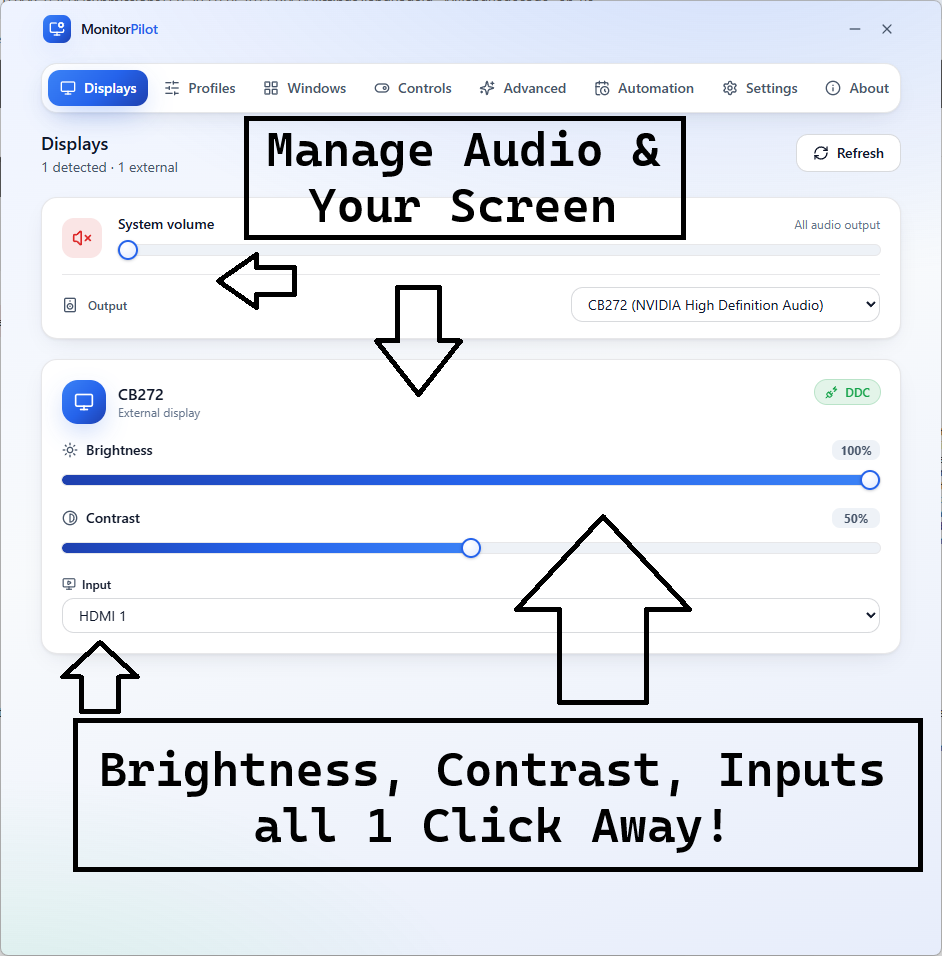
MonitorPilot dashboard showing each external display as a card with brightness, contrast, and volume sliders
Every external display in one window — brightness, contrast, input, volume, and colour at a glance, straight from the tray.

Control every monitor, then let your desk run itself.

MonitorPilot drives brightness, contrast, input, volume, and colour over standard DDC/CI—no drivers—then adds the automation and reliability layer free slider tools skip.

Profiles & per-app rules: switch the whole desk in a click, or apply settings automatically when an app takes focus.
Docking-safe by design: panels are keyed by hardware EDID, so settings never land on the wrong screen after a reconnect.
Native & private: Rust + WebView2 (not Electron), under 15 MB idle RAM, 100% offline, no account, no telemetry.

Especially when

  • Control external monitor brightness, contrast, input, volume, and color on Windows 11 without fumbling with the buttons under the bezel
  • Automate per-app and time-of-day monitor settings across a multi-monitor desk instead of adjusting each screen by hand
  • Restore the correct display settings after docking or undocking without Windows reshuffling which monitor is which

Who benefits

Real-world scenarios

The fullscreen gamer

Mid-match the screen feels too bright, but the only way to fix it is to break focus, minimise, and dig through a menu — by which point the moment, and maybe the round, is gone.

You press a MonitorPilot global hotkey and the panel dims two notches without leaving the game, or scroll the tray icon between rounds — no alt-tab, no lost concentration.

The disappearing brightness slider

You plug a desktop monitor into your laptop and the Windows brightness slider stops working — it only ever dimmed the built-in panel, and now you're reaching under the bezel for tiny buttons every evening.

MonitorPilot exposes brightness, contrast, and colour for that external display as tray sliders, so dimming the screen at night is one click instead of a hunt for unlabelled hardware buttons.

The window wrangler

You spend the day dragging windows between three monitors and snapping them into place, and after a reboot or an app update your careful arrangement is scattered again.

MonitorPilot moves and snaps windows with global hotkeys, parks each app on the right monitor as it opens, and rebuilds a saved layout instantly, so the arrangement reassembles itself.

Deep dive

Global hotkeys and tray-scroll: brightness without breaking focus

The reason changing an external monitor's brightness feels disruptive is that the usual paths all demand your full attention: reach for the bezel, open a menu, or alt-tab to a control window. In a game or a fullscreen app, any of those can cost you the moment. MonitorPilot removes the interruption by making brightness something you command from the keyboard or the tray, without surfacing a window at all. You can bind global hotkeys that raise or lower brightness on the fly, and a separate chord that brings the app forward only when you actually want the full controls. Scrolling the wheel over the tray icon nudges brightness directly, which is ideal for a quick tweak between rounds or scenes. Because MonitorPilot identifies each panel individually, the shortcuts can target a specific display rather than blasting every screen at once — so "dim the right monitor two steps" is a single keystroke. The hotkey layer also reaches the rest of the app: you can summon a workspace, move windows, or apply a layout from the keyboard, turning common multi-monitor chores into muscle memory. Everything is processed locally with no network involvement. The one hardware caveat is the standard one for brightness control: the display must support DDC/CI, which the great majority of external monitors do, while laptop built-in panels generally do not.

Trusted by pragmatic desktop users

Built for people who prefer tools that stay local.

Real workflows: focus timers that stay visible, batches that never leave the disk, and renames you can rewind.

Customer review 01

PinPoint: Always On Top saves me so much time as I can organize all my report materials without having to flip between windows or tabs. I love the fact that it is straightforward and simple.

Senior Accountant · Manufacturing Company · United States · PinPoint

Learn more
Customer review 02

I used to get so frustrated when my Taskbar would freeze and disappear. Taskbar Sentinel has eliminated that pain without subjecting me to another subscription.

Darren · Calgary, Alberta, Canada · Taskbar Sentinel

Learn more
Customer review 03

OpticBatch and MetaForge are a lifesaver for me as a person with a passion for photography. They give me the ability to stay organized and keep personal information confidential when I post pictures online.

Sherri · United States · OpticBatch & MetaForge

Learn more

Quotes are shown with customer permission; names and locations appear as reviewers provided them.

Our Core Moat

Engineered to respect your system boundaries.

System Resource Monitor (Idle State Comparison)
Automata Labs sub-5MB idle memory footprint compared to generic Electron applications

Lightweight Native Stack

Compiled Rust core wrapped inside an optimized Tauri shell. No heavy background node loops or duplicate Chromium engines cooking your memory footprint (<5MB idle RAM).

100% Local-First Privacy

Executes entirely on-device with full offline isolation. Absolute zero background telemetry policies, no metrics aggregation, and zero mandatory cloud-sync accounts.

Perpetual Fallback Licenses

Pay a single, clear one-time purchase price. Own your specific native software utility execution tier permanently without artificial subscription paywalls or ongoing usage tax.

FAQ

Straight answers—no glossary dump

Can I change external monitor brightness with a keyboard shortcut on Windows?

Windows has no built-in shortcut that adjusts an external display. MonitorPilot adds configurable global hotkeys that raise or lower brightness from any app or game, plus a chord that summons the window and tray-scroll to nudge a level directly. Because it identifies each panel separately, a shortcut can target one specific monitor instead of every screen at once.

Does MonitorPilot require drivers, an account, or an internet connection?

None of the three. MonitorPilot controls monitors over standard DDC/CI with no kernel drivers, needs no account or sign-in, and makes no network calls — it is fully functional offline. It is a native Rust app with a WebView2 front end, targeting under 15 MB of idle RAM and a quick cold start, so it stays quietly in the tray until you need it.

Will MonitorPilot work with my monitor and my laptop screen?

MonitorPilot controls external displays that support DDC/CI, which covers most modern monitors (some need it enabled in their on-screen menu). Laptop built-in panels generally do not expose DDC/CI and can't be controlled this way — a hardware limitation, not a MonitorPilot one. Window management, global hotkeys, and system volume still work regardless, so a laptop setup keeps real value.

Is MonitorPilot a subscription, and how do I get it?

MonitorPilot is a one-time purchase on the Microsoft Store — no subscription and no account required for core use. Because DDC/CI support is hardware-dependent, trying it on your own displays is the best way to confirm they respond. Use the Microsoft Store button on this page for the current listing and price.

Free tools adjust sliders.
MonitorPilot runs your whole desk.

MonitorPilot controls every external display over DDC/CI—brightness, contrast, input, volume, and color—then automates the desk with profiles, per-app rules, workspaces, and window management. Native Rust, under 15 MB idle RAM, 100% offline, no drivers, no account.

$14.99 USD — Perpetual License

One-time purchase · Lifetime updates · Delivered via the Microsoft Store

Purchased and updated securely through the Microsoft Store. No account needed on our site, no subscription, and a Microsoft receipt for easy corporate expensing.

Open full product page

Technical specifications

Technical specifications for procurement

Spec Implementation
Data Sovereignty Profiles, rules, workspaces, and per-monitor names are stored locally; no cloud sync or remote backup
Telemetry Status None; no account, no analytics, and no outbound network access by policy
Core Runtime Rust core with a WebView2 front end (not Electron); controls displays over standard DDC/CI
Network Requirements Fully functional offline; sunrise/sunset and adaptive brightness are computed on-device with no location lookups
Deployment Compatibility Windows 11 only; controls external DDC/CI displays (laptop built-in panels generally do not expose DDC/CI)
Controls Brightness, contrast, input source, volume, color temperature, and power per display
Automation Profiles, per-app context switching, and a rules engine over app/time/solar/battery/idle/full-screen/virtual desktop
Reliability EDID-hash stable identity, serialized bus-safe DDC queue, and crash-safe transactional settings
Footprint Target under 15 MB idle RAM and sub-250 ms cold start (verified on QA hardware)